Review · smart glasses
Even Realities G1 Review: A Heads-Up Display Nobody Can See
The Even Realities G1 hides a monochrome HUD inside normal-looking prescription glasses. No camera, no speakers, just discreet AI, navigation, and notes for $599.
Disclosure: We earn commissions from links on this page, as an Amazon Associate we earn from qualifying purchases, at no extra cost to you. This never affects what we recommend. Read our editorial standards →
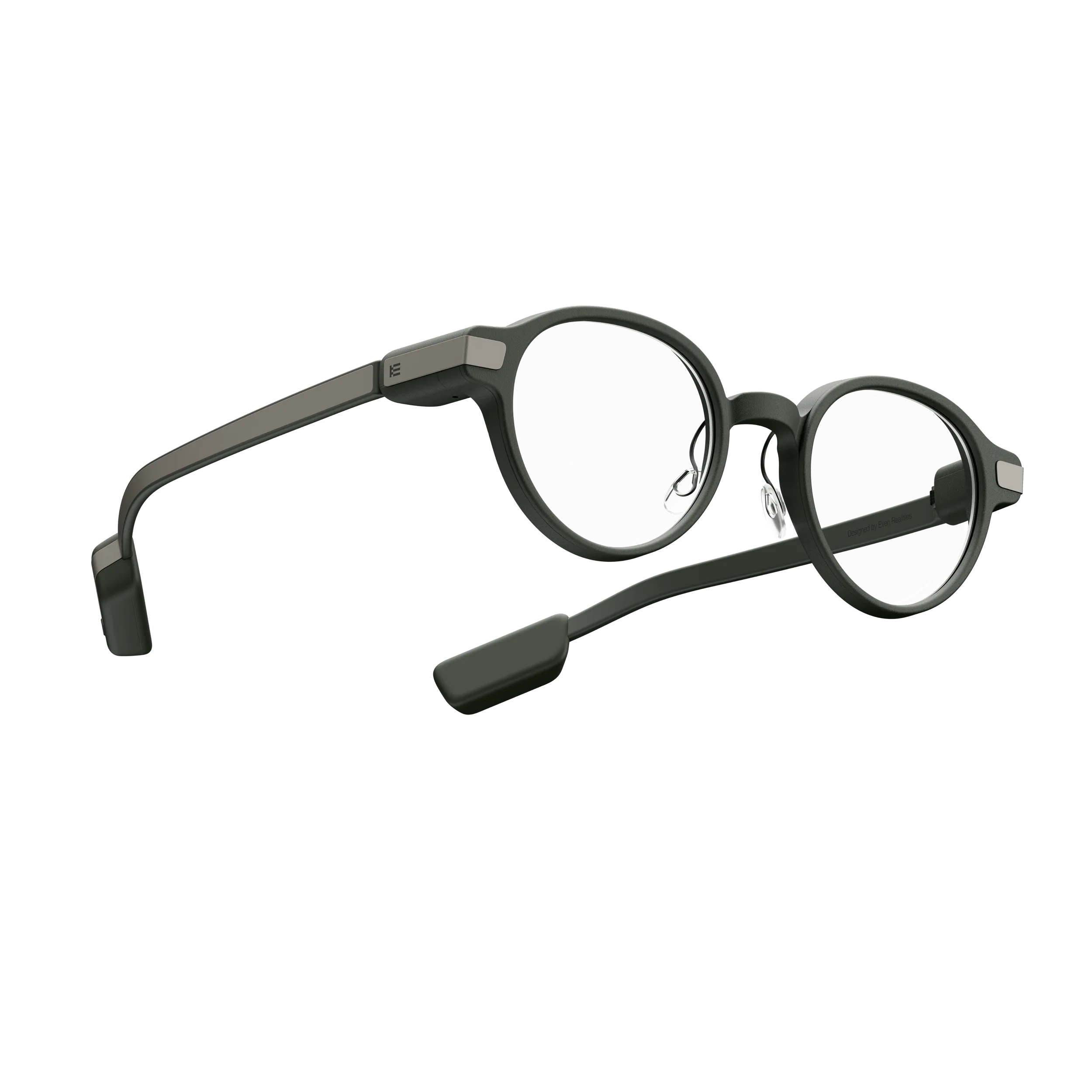
Even Realities
Even Realities G1
Synthesis score
$599
The most wearable display glasses here: a real HUD inside frames nobody reads as smart. The trade is steep: no camera, no speakers, monochrome only, and $599 for a narrow tool. For minimalists who want notes and navigation in their lens, nothing else looks this normal.
Pros
- +The disguise is the feature: a real monochrome green waveguide display sits in both lenses, yet the frames look like ordinary designer glasses nobody clocks as smart
- +Genuinely light at around 44g, lighter than most camera-equipped rivals, so they wear like normal eyewear all day
- +The HUD does the quiet-utility jobs well: turn-by-turn navigation, a teleprompter, live notes, translation, and quick AI answers in your field of view
- +Prescription is built into the lens rather than clipped on, and battery runs roughly 1.5 days of light use, far longer than display rivals
- +No camera means no red-light privacy stigma; you can wear these in places that ban recording glasses
Cons
- −No camera and no speakers at all; this is a display-and-text device, not a capture or media tool, which will disappoint anyone expecting Ray-Ban Meta features
- −The display is monochrome green, not full color, so it is for glanceable text and directions, not rich visuals
- −At $599 it costs more than the far more capable Ray-Ban Meta Gen 2, and you are paying for discretion, not breadth
- −It leans heavily on a paired phone and the Even app; the glasses are a second screen, not a standalone computer
- −Even Realities has already announced a G2 successor, so buying the G1 now means buying the outgoing model
This review is part of our buyer's guide, Best AI Smart Glasses in 2026, which compares every pick side by side.
Almost every display in this guide announces itself: a chunky frame, a camera dot, a faint glow. The Even Realities G1 takes the opposite bet. It buries a working heads-up display inside glasses that look like something from an upscale optician, with no camera and no speakers to give the game away. The result is the most wearable display glasses you can buy, and the most narrowly focused.
This is a synthesis review. We have not tested these glasses ourselves; every figure below traces to a cited source.
The case for invisibility
The G1 is built around one idea: a HUD you can wear anywhere without anyone noticing or objecting. The monochrome green waveguide shows directions, notes, a teleprompter, translation, and brief AI answers in your field of view, and the frames weigh around 44g with the prescription built into the lens. Because there is no camera, there is no red-light stigma and no room you cannot wear them into. For people who found Ray-Ban Meta’s camera socially awkward, that is the entire pitch, and it lands.
The cost of that focus
You pay for the discipline. There is no camera, no speakers, a monochrome rather than color display, and a $599 price that sits above the far more capable Ray-Ban Meta Gen 2. The glasses also lean on a paired phone for the heavy lifting; they are a second screen, not a standalone device. And Even Realities has already announced a G2, so the G1 is the outgoing model. None of this is a flaw so much as a boundary: the G1 does a small number of things invisibly, and nothing else.
Where the score comes from
Our synthesis score is 7.5. It reflects real credit for being the only display glasses that pass as ordinary eyewear (44g, prescription in-lens) and for a readable HUD that handles navigation and notes well. We dock it hard for the deliberate omissions, no camera, no speakers, monochrome only, the $599 price above the more capable Gen 2, and the fact a G2 successor now exists. A high score for a narrow job done well, not for breadth.
Who should buy it
Buy the G1 if you specifically want navigation, notes, and quiet AI in your lens, in glasses no one reads as smart, and you do not care about a camera or audio. If you want the broader everyday package, the Ray-Ban Meta Gen 2 does more for less. The G1 is a specialist, and for the right minimalist it is the only pair that fits.
Frequently asked questions
Does the Even Realities G1 have a camera?
What can the HUD actually display?
Can I get the G1 in my prescription?
Should I wait for the Even Realities G2?
Sources
Every claim in this guide that isn't first-person experience is traceable to one of the sources below. URLs verified at publication; some may rot. Let us know if so.
- Even Realities G1 review: style over substance — WearableBeat
- Even Realities G2 AR glasses and R1 ring: specs and features — Geeky Gadgets
- Even Realities G1 product page — Even Realities