Review · smart glasses
Meta Ray-Ban Display Review: The First AI Glasses That Feel Like the Future
Meta's $799 Ray-Ban Display puts a full-color HUD in one lens and a neural wristband on your arm. The most polished AI glasses yet, with first-gen caveats.
Disclosure: We earn commissions from links on this page, as an Amazon Associate we earn from qualifying purchases, at no extra cost to you. This never affects what we recommend. Read our editorial standards →
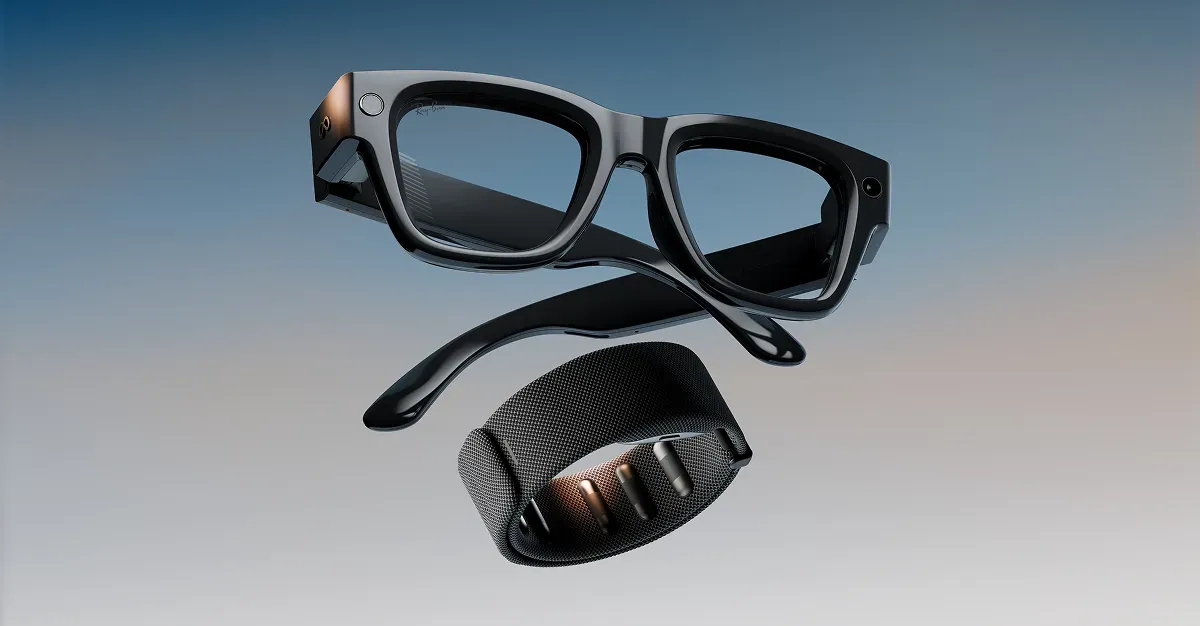
Meta / Ray-Ban
Meta Ray-Ban Display
Synthesis score
$799
The most complete AI glasses you can buy in 2026, and the first with a display worth wearing. The $799 price, single-lens display, and 6-hour battery mark it as a first-generation flagship for early adopters, not the mainstream buy. If you want the future today, this is it.
Pros
- +The display is genuinely usable: a 600 by 600 full-color screen in the right lens with a 90Hz refresh, roughly 20-degree field of view, and up to 5,000 nits, so it stays readable in daylight where rivals wash out
- +The Meta Neural Band is the standout: an sEMG wristband that reads finger gestures, so you scroll and select without voice or touching the frames, rated IPX7 with about 18 hours of battery
- +12MP ultra-wide camera shoots 3K video, plus a viewfinder in the lens so you finally see what you are capturing, with 32GB storage and Wi-Fi 6
- +Reviewers were impressed: Tom's Guide called the experience a big leap forward for the category and said the glasses feel like the future, praising the crisp display and intuitive wrist gestures
- +Prescription-ready (-4.00 to +4.00) and IPX4 water resistant, so they work as actual everyday glasses, not just a demo unit
Cons
- −At $799 plus the included Neural Band, they cost more than double the cameras-and-audio Gen 2, and that buys a first-generation display, not a finished category
- −The display is monocular (right lens only), which takes adjustment and is not true binocular AR
- −Up to 6 hours of mixed-use battery means real-world heavy use lands lower; the folding case adds about 24 hours but you are charging often
- −Limited retail availability since the September 2025 launch; this is still an early-adopter product sold through select channels
- −At 69g they are noticeably heavier than ordinary Wayfarers, and the look is chunkier than the camera-only Ray-Ban Metas
This review is part of our buyer's guide, Best AI Smart Glasses in 2026, which compares every pick side by side.
Smart glasses have promised a display in your field of view for a decade and mostly delivered washed-out demos. The Meta Ray-Ban Display is the first pair where the screen earns its place. A full-color panel sits in the right lens, bright enough to read outdoors, paired with a wristband that lets you control it with finger movements so subtle nobody around you notices. For the first time, the sci-fi pitch mostly matches the product.
This is a synthesis review. We have not tested these glasses ourselves; every spec and quote below traces to a cited source.
What it gets right
The two hard problems in this category are a display you can actually see and an input method that does not make you look like you are talking to yourself. Meta solved both. The 5,000-nit screen stays legible in daylight, and the Neural Band reads finger gestures off your wrist, so navigation is quiet and quick. Add a 12MP camera that shoots 3K with an in-lens viewfinder, and you get the most coherent AI-glasses experience yet. The reviewer reaction backs it up: critics who normally temper their enthusiasm came away impressed by the display and the gesture control.
Where the first generation shows
This is a 1.0 product wearing a flagship price. The display is monocular, the battery is a real 6 hours rather than all-day, the frames are heavier and chunkier than the camera-only Ray-Bans, and availability has been limited since launch. None of that makes them bad; it makes them an early-adopter device. You are paying $799 to be first, and to subsidize a category that is still finding its feet.
Where the score comes from
Our synthesis score is 9.0. It reflects the strongest reviewer consensus in the category, with Tom’s Guide calling it a leap forward and praising the display and the Neural Band, plus a spec sheet nothing else matches: a usable 5,000-nit display, gesture input, and a 3K camera. We dock it for the first-generation realities every reviewer also flags, the $799 price, the single-lens display, the 6-hour battery, and limited availability. The number reflects best-in-class capability, not a finished mainstream product.
Who should buy it
Buy the Display if you specifically want an in-lens screen and gesture control and you are comfortable being on the frontier. If your real wish list is a camera, open-ear audio, and a voice assistant in glasses that look normal, the Ray-Ban Meta Gen 2 does that for $379 and is the smarter everyday buy. The Display is the most impressive pair in the category and the least sensible value, both at once.
Frequently asked questions
What is the Meta Neural Band and do I have to wear it?
Is the display in both lenses?
How is the battery life?
Are they worth $799?
Sources
Every claim in this guide that isn't first-person experience is traceable to one of the sources below. URLs verified at publication; some may rot. Let us know if so.